Tree Trimming in Port Charlotte, FL
Good trimming in Port Charlotte is mostly about wind. A crown that lets air through, limbs that are not resting on the roof, and no big stubs left to rot are what decide whether a tree is still standing after the next storm.
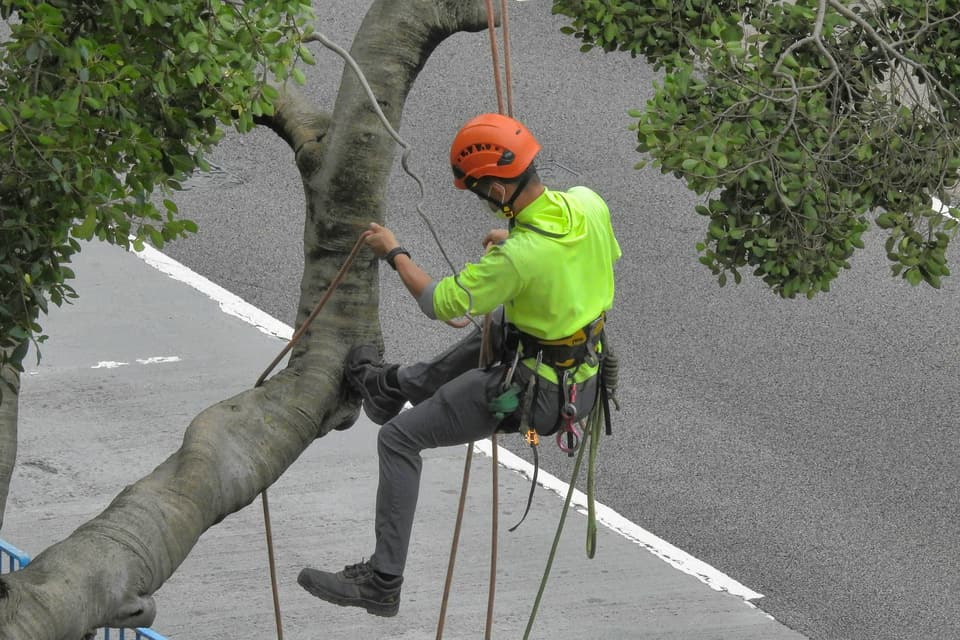
What the job actually involves
A proper trim starts on the ground. Someone walks round the tree, looks at the base and the root flare for decay or fungus, looks up for dead wood, cracks and limbs rubbing each other, and works out where every cut piece is going to land. On a typical Port Charlotte lot that last part matters: the house, the lanai cage, the pool and the neighbour's fence are usually all inside the drop zone.
Dead wood first
Dead limbs are the cheapest risk to remove and the first thing to go in a storm. On a laurel oak they are also a signal. Dieback at the top of the crown often means trouble at the roots or the trunk, and it is worth asking the person quoting to look at the base before anyone climbs.
Thinning, not stripping
Thinning takes selected branches out at their point of origin so wind can pass through the crown. It should leave the tree looking like itself. The working rule in the pruning standards is to remove no more than about a quarter of the live canopy in one season. A tree that looks half empty after a trim has been over-pruned, and it will answer with a flush of weak sprouts.
Clearance
Lifting the lower limbs over a driveway or a sidewalk, and pulling the crown back off the roof and the screen enclosure. Limbs that touch shingles wear them, drop leaves into gutters, and give rats an easy way onto the roof. They also hammer the roof in a storm.
Structure, on younger trees
A live oak that is ten or fifteen years old is the best tree in the yard to spend money on. Choosing one main trunk and shortening the competing ones now prevents the split, v-shaped union that fails at twenty-five years.
Why it is different here
The trees are not the ones in national advice. Port Charlotte's yards are mostly laurel oak, live oak, slash pine, cabbage palm, queen palm, and on older lots the occasional Australian pine or Brazilian pepper that seeded itself. Each behaves differently in wind, and that changes what a good trim looks like.
Laurel oak
Fast-growing, common, and short-lived. University of Florida research puts the onset of decay at roughly 40 to 60 years, and laurel and water oaks were over- represented among trees that fell in the Florida hurricanes UF studied. Many Port Charlotte laurel oaks went in with houses built from the 1960s onward. Trimming one that age is worth doing only after someone has checked the base.
Live oak
The tree to keep. Live oaks have among the best wind records of anything planted in Florida, but their long, heavy lateral limbs need reducing at the ends rather than cutting back to stubs, and they need clearance work as they spread over a roof.
Slash pine
There is not much to prune on a pine beyond dead limbs. The real question with a pine is whether it should be there at all: tall, close to the house, and on many Peachland-area and North Port lots standing on the edge of an unbuilt lot with its root zone disturbed by construction next door.
Spanish moss
It does not harm the tree. It is an epiphyte, not a parasite, and pulling it out is cosmetic. Heavy moss on a thin, declining crown is a sign of a tree that has lost leaf cover, not the cause of it.
Topping is prohibited, and it should be
Topping means cutting the whole crown back to stubs to make a tree shorter. It is the quickest way to turn a sound tree into a hazard: the stubs rot, the tree throws up dense, weakly attached sprouts, and in three or four years the crown is as tall as before and far more likely to shed limbs in wind. Charlotte County's own tree permit guidance says topping or "lollipopping" is strictly prohibited and that pruning is to follow national arborist standards. If a quote describes cutting the tree "back by half" or "to the main trunk" to make it storm-safe, that is topping under another name, and you should not pay for it.
Power lines are a different job
Federal safety rules keep anyone who is not a qualified line-clearance worker at least ten feet from an energized overhead line. That rules out most residential tree crews for limbs in the primary lines along the street, and it certainly rules out a homeowner with a pole saw.
Limbs near the main lines are FPL's to deal with, and the request goes to them. The service drop, the single line from the pole to your house, is usually the owner's responsibility to keep clear, and the safe way to do that is often to ask the utility to drop or de-energise it while the work happens. A tree company that works in Charlotte County will know how to arrange that. Ask before the day.
When to trim in Port Charlotte
Most trees here can be pruned at any time of year, and the timing question is really about storms and labour. Pruning is a calm-weather job, and the sensible window is from the end of one hurricane season, in late November, to the start of the next on June 1. Search data for this area says that is also when people think of it: searches for tree trimming in Port Charlotte run around twenty times higher in November than in June.
Two things argue for not waiting until May. Tree companies here are small, and the spring calendar fills with everyone who meant to do it in winter. And after a named storm, every crew in Charlotte County spends weeks on emergency work, so a routine trim booked for August can slip to October.
Get the pre-season prune on the calendar. Call for a free estimate and a local tree company will look at what is over the house now, before June.
Waterfront lots and mangroves
Canal and river lots in Harbour Heights, Charlotte Harbor and along the Myakka in El Jobean sometimes have mangroves at the shoreline. Mangrove trimming is governed by state law, not the county's tree permit. Within the rules a homeowner may trim some mangroves on a residential shoreline fringe, but not below six feet, and once they are taller than ten feet the work needs a professional mangrove trimmer. Rules depend on the shoreline, so treat that as the question to ask rather than the answer, and confirm with the Florida Department of Environmental Protection before anyone cuts.
What a written estimate should say
Which trees, and what is being done to each: dead-wooding, thinning, clearance, reduction, and roughly how much is being taken. Whether the wood and brush are hauled away or left cut to length, because curbside collection here will not take limbs longer than six feet, thicker than ten inches, or heavier than forty pounds a piece. Whether anything is near a line. And proof of liability insurance, plus workers' compensation or an exemption, before anyone climbs. Florida has no state licence for tree trimming, so insurance and references are what separate a real company from a truck and a chainsaw.
| Tree | Wind record | What trimming usually means | Watch for |
|---|---|---|---|
| Live oak | Among the best | End-weight reduction on long limbs; roof and drive clearance | Stubs from old storm breaks |
| Laurel oak | Poor, especially past 40–50 years | Dead-wood removal, light thinning, only after checking the base | Mushrooms or hollows at the base, top dieback |
| Slash pine | Moderate; snaps when roots are damaged | Dead limbs only; there is little to shape | New lean, cracked soil, resin streaks from beetles |
| Cabbage (sabal) palm | Excellent | Dead fronds and seed stalks; boots optional | Over-trimming to a "pencil" head |
| Queen palm | Poor | Dead fronds and fruit; nothing green | Shelf fungus or soft spots low on the trunk |
Where we work in Port Charlotte
- MurdockNorthwest Port Charlottewhere SR 776 meets US 41, around the county offices on Murdock Circle; many of the shade oaks are as old as the houses, which for a laurel oak is the age decline starts
- Charlotte Harbor & southeast Port CharlotteSoutheast, along US 41Charley's eyewall crossed here in 2004 and Ian's eye in 2022, so a lot of what stands now is either a survivor with old wounds or a replacement planted since
- Harbour HeightsEast, on the Peace Riverriverfront lots with big live oaks and cabbage palms; where the shoreline carries mangroves, state trimming rules apply before anyone picks up a saw
- Peachland Boulevard areaNorth Port Charlottenewer houses on the original platted lots, often next door to an unbuilt lot of slash pine and saw palmetto; pines leaning over a roof are the usual call
- Gulf Cove & South Gulf CoveWest, toward the Myakkasailboat-access canals and mostly newer construction, so the trees are younger: palms, and the shade trees planted to meet the county's tree-point rule
- El JobeanWest, on SR 776 at the Myakka Riveran old fishing settlement with mature oaks and cabbage palms on open, wind-exposed lots close to the river
ZIP codes served33948 · 33952 · 33953 · 33954 · 33980 · 33981
Common questions
What does tree trimming cost in Port Charlotte?
Local companies generally quote around $350 to $1,500 for a proper prune on a mature oak and $75 to $250 a palm for routine palm work. A small ornamental can be well under that, and a large oak over the house with no bucket-truck access can be well over. Height, access, the drop zone and haul-away move the price far more than the tree species does. We do not set prices; the company that quotes you does.
Do I need a permit to trim a tree?
Not for trimming or pruning a tree on your own property in unincorporated Charlotte County, according to the county's tree permit guidance. Pruning is expected to follow national arborist standards, and topping is prohibited. Trees in the road right-of-way are the county Public Works Department's, and removing a tree is a separate question that often does need a permit.
How often should trees be trimmed here?
Palms usually once or twice a year, depending on species. Mature oaks every three to five years for thinning and clearance, sooner if limbs are on the roof. Young shade trees benefit from a structural prune every couple of years until the main framework is set.
Is it too late to trim before hurricane season?
It is only too late once a storm is forecast. From then on, nobody should be climbing, and anything cut has to be cleared before the wind arrives rather than left on the curb. If it is May, call now; if it is August, a calm week between systems is still a reasonable time to deal with the worst limbs.
Will trimming make my tree hurricane-proof?
No. It reduces the odds. Removing dead wood, thinning so wind passes through, and taking weight off long limbs all help, and UF research found properly pruned trees held up better. But a tree with a decayed base or a cut root plate can fail however well its crown is pruned, which is why the base gets checked first.
My neighbour's oak hangs over my roof. Can I trim it?
Generally you may trim branches that cross onto your property, back to the line, as long as you do not harm the tree as a whole, and you may not go onto their land to do it. It is far simpler to talk to them first. Many people split the cost of a single trim that does both sides properly.
Do you trim around a lanai cage?
The tree company does, and it is routine here. Branches are lowered on ropes rather than dropped, and the cage is the first thing the estimate should account for. Ask how they protect it.
Should the crew be ISA certified?
It is a good sign, not a legal requirement. Florida does not license tree trimmers. An ISA Certified Arborist has passed an exam on tree biology and pruning practice, and only an ISA arborist or a Florida landscape architect can sign the risk assessment that lets a dangerous tree come down without a local permit.
Other tree work in Port Charlotte
- Tree Removal in Port Charlotte, FL
- Palm Tree Trimming in Port Charlotte
- Storm-Damaged Tree Removal in Port Charlotte
- Stump Grinding in Port Charlotte
Also serving
Tree Trimming is available beyond Port Charlotte, across North Port , Punta Gorda and Venice .
Get an estimate for tree trimming
Tell us about the tree and a local tree company will come and look, usually within a few days. Answered Mon–Sat, 7:30am–6pm · after hours we call back the same day Or call (941) 368-3545 — most people get an answer faster that way.